

An Irrigation Ditch Runs Through It: What property owners need to know
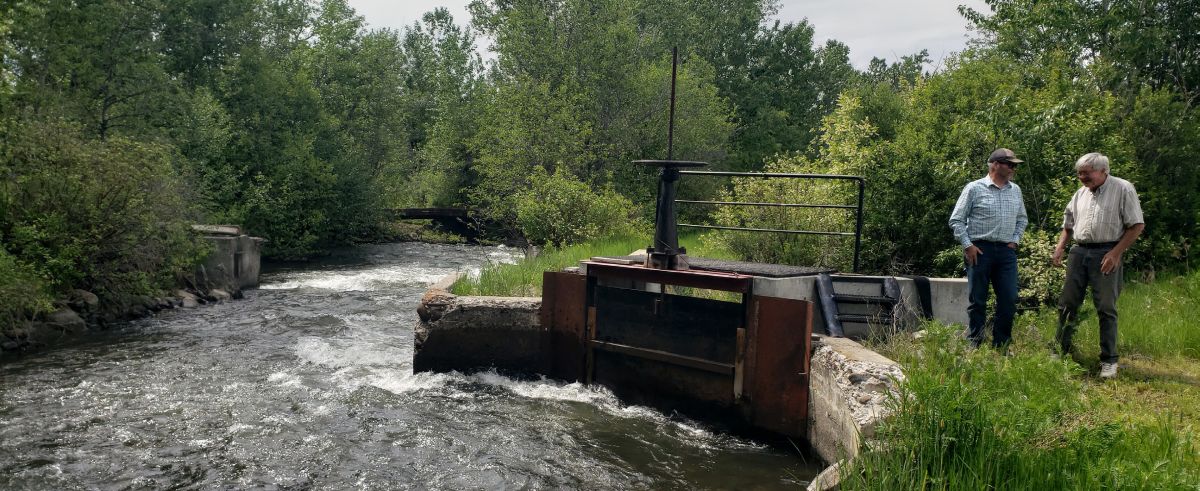
Water has been used for irrigation in Montana for over 150 years. Irrigation ditches flow across many Montana landscapes and play a critical role in providing water for agriculture. These ditches also recharge groundwater and wetlands, create wildlife habitat, and more. If a ditch crosses a property, it brings with it certain legal requirements and responsibilities. Ditches are more than just waterways — they are working agricultural infrastructure rooted in Montana’s property law and agricultural history. By understanding the legal foundations of ditches and water rights, and maintaining open communication, landowners can avoid legal entanglements and can help maintain good-neighbor relationships.
Irrigation ditches are man-made channels into which water from natural streams and rivers is diverted. They commonly have straight or uniform sides but may also have the appearance of a natural stream. Their primary purpose is to deliver water from one location to another, and they require routine maintenance to ensure efficient water delivery and to prevent flooding or damage to surrounding property.
Water Rights and Ditch Rights
Like most Western states, Montana follows the prior appropriations doctrine for administration of water rights, which is “first in time is first in right.” The earliest users on a stream have priority over later users when water supplies are limited. Senior water rights are entitled to divert their full measure of water before junior rights use water.
Water rights are limited to a “place of use,” which refers to the location where water is applied to a beneficial use. “Beneficial use” is the foundation of all water rights, which establishes what water can be used for, how much can be used, and when it can be used. Common beneficial uses include irrigation, stock water, domestic, municipal, industrial, recreation, and instream flow. Each water right is limited to the amount of water that is actually put to use.
Ditch rights, on the other hand, are separate from water rights and relate to the ditch owners’ right to the flow of water and the right to maintain the ditches, even where they cross private property. Ditch owners typically hold a prescriptive easement for the established path of the ditch, as well as a secondary easement that allows access for maintenance. These easements are private property interests that are protected under state law.
Duties of a Ditch Right Owner
Historically, the cumulative amount of water associated with water rights determined the ditch size and capacity. Irrigation ditches rely on headgates, flumes, and other control structures to regulate water delivery from a point of diversion. Ditch owners have a duty to maintain infrastructure to ensure safe and reliable operation. Under Montana law, ditch owners are not required to fence ditches, install grates, or restrict access where ditches pass underground, under bridges or beneath structures. They are also not responsible for preventing access to ditches by people or animals unless otherwise specified. When multiple water users rely on the same infrastructure, they may form a ditch company. A ditch company maintains the shared headgates and conveyance system needed to divert and deliver water.
Dos and Don'ts for Landowners
In Montana, landowners with live water on or adjacent to their property have specific rights and obligations. Understanding these responsibilities can help avoid conflicts and support good neighbor relationships.
- Do determine whether the watercourse is a stream or a ditch. If the watercourse is a natural stream, any proposed alterations may be subject to legal requirements. Landowners should contact their local conservation district before beginning any work in or adjacent to the stream. If the watercourse is an irrigation ditch, landowners must contact the ditch owners before beginning any work.
- Do understand easements and access rights. Water right ownership in Montana can be separate from land ownership, though generally water rights transfer as an attachment (appurtenance) to land. Property owners can check deed language and chain of title for more information, and water rights information is available on the Department of Natural Resources and Conservation website (dnrc.mt.gov). The water rights section has many resources, including regional office contacts, a detailed lookup tool by name or entity, and more.
Ditch rights and easements can be found by contacting the ditch company or a water user on the ditch to understand specifics. Access for maintenance occurs on both sides of a ditch and water users have a ditch right to convey water identified on their water right. For more information, visit the Association of Gallatin Agricultural Irrigators, agaimt.com.
Maintenance of ditches is paid for by ditch owners or water users and is typically not a public expense. Secondary easements allow access for maintenance, which may include the use of heavy equipment crossing private property. Maintenance activities can involve removing debris, restoring ditch banks, and re-establishing the ditch bed. Debris removed during maintenance may be placed along the ditch bank, even if that bank is within a yard or field.
- Do communicate with ditch owners about pesticide use near ditches. Weed control is the responsibility of the landowner. Many herbicides are not safe
for use in or near water, and improper application can result in chemicals being transported
downstream through a ditch. Coordination with ditch users can help prevent
unintended impacts. - Don’t alter or obstruct a ditch without approval from the ditch owner. The path of a ditch is protected by both a primary easement for the conveyance of water, and a secondary easement for maintenance. Landowners may not relocate, fill, pipe, or otherwise alter the ditch without prior approval from the ditch owners. Secondary easements allow access for maintenance, with widths varying depending on location and ditch needs. Landscaping, fencing, or debris that impedes water flow can injure a water right and may result in additional maintenance costs or disputes.
- Don’t use ditch water without a valid water right. Water from a ditch may only be used by those with a water right. Water right holders are responsible for maintenance costs and must limit their use to the amount specified in their right. Unauthorized use can interfere with downstream users and may result in legal consequences.
Additional Information
Montana State Legislature, Interim Water Policy Committee 2013 Report, HJ26: archive.legmt.gov/content/Committees/Interim/2013-2014/Water-Policy/Meetings/July-2014/DRAFT-HJ26-report_July14.pdf
Rebecca Krueger is the Partnership Coordinator with the
Association of Gallatin Agricultural Irrigators.