


4-H Projects
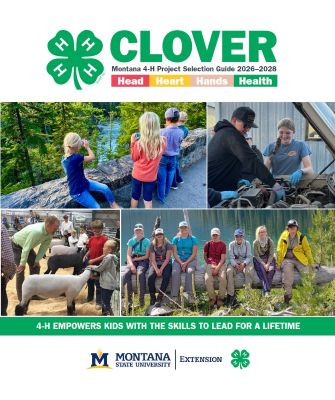
Listed below are all projects offered on a statewide basis to youth enrolling in 4-H clubs in Montana.
Statewide projects are under the priority initiatives of Science, Citizenship and Healthy Living.
Projects should be completed in order, starting with Level 1.
Check with your 4-H leader or MSU Extension agent to see which projects are offered in your area. Not all projects listed on this page may be available in your community.
Some counties and reservations offer projects in addition to those listed here. These projects meet a specific need within the community 4-H program. If you are interested in these, contact your county’s MSU Extension Office to find out more. Many projects also have opportunities for sharing and learning about your unique skills and talents through project achievement programs. Contact your MSU Extension Office to find out how to meet these goals.
As you look for projects, all the information needed to enroll is on its respective webpage. See the example [below].
Using this Guide
This guide lists all projects offered on a statewide basis to youth enrolling in 4-H clubs in Montana. As you look for projects, all the information needed to enroll is here in the guide. See the example below.
M Materials for the 4-H member enrolling in the project
L Materials for 4-H leaders
S Supplemental materials for leaders and/or members. These materials are optional.
Example of a project listing page and how to use it:
Cat (Subcategory Title)The Subcategory Title section gives a general description of what can be learned by completing the projects within. |
|
Cat, Level 1 (Project Title & Level)The Project Title & Level section gives a more specific description of a project, what is involved and what can be learned. As levels increase, so do project requirements and learning challenges. This section explains what is needed to complete a project book and finish the project. This section provides a material list for members and leaders. See letter key above. M Purr-fect Pals, BU8148 (Material names and publication numbers are linked to the product page for purchase. Some materials are sold by the MSU Extension store, while many others are available from Shop 4-H.) L Cat Group Helper’s Guide, BU8151 |
Additional Resources for All LevelsAdditional project resource material will be listed in the right-hand sidebar. |
End of example.
Montana 4-H curriculum follows the Experiential Learning Model, which ensures "learning by doing." Learn about the Experiential Learning Model and how to use it while planning project activities.
Looking for more project resources? Check out CLOVER by 4-H to find hundreds of online learning activities!
Science
Animal Science projects teach subject matter related to each animal while helping youth develop life skills. In each level, youth choose from a variety of learning experiences to develop an inquiring mind and a desire to seek out the scientific principles involved in raising animals. Youth can develop leadership, initiative, self-reliance and sportsmanship through project activities. Youth will learn to accept responsibility by having an animal to care for regularly and the principles of animal nutrition.
Through animal science projects, youth also learn to care for, train and handle animals safely. Youth will better understand and apply research in making wise decisions and investments and use it in managing animals. It is important that families discuss the reality of owning and caring for all animals. All animal projects require time and resources.
Are “We” ready for a 4-H Livestock Project?
Parents: Showing an animal at the county fair is an educational and memorable experience for youth in the 4-H Livestock projects. Showing livestock builds confidence and character in young people. They learn how to select, care for and keep records on their project. From the time that an animal project is started until it is finished, the youth is responsible for a major part of the daily care of their project.
Successful 4-H members have caring adults in their lives who are truly enthusiastic about projects the members are taking. It is important that adults provide supervision, assistance and encouragement to the 4-H members they work with. If adults are willing to help in these ways, it will make a difference in the life of a young person. However, adults need to be aware that while assisting is clearly important, it is equally important that adults not go too far with helping. It is important for caring adults to support and assist to a reasonable extent, but not to complete the chores and requirements for the project. It is also inappropriate for a professional to own, care for, or groom the project animals.
Families are encouraged to have realistic conversations about the time and resources that livestock projects require. Livestock projects will require a minimum of one hour daily to meet basic needs, such as feeding, watering and veterinary care. Market beef projects typically start in November or December and continue through July or August. Pig, sheep and goat market projects start in April or May and continue through July or August. Horse, dairy cattle and goats, rabbit, poultry, and breeding projects are a year-round commitment for both the member and family. Training and preparing an animal for show will take several additional hours per day throughout the year.
Each county fair or show in Montana will have its own unique policy and guidelines. It is the members’ and parents’ responsibility to read and understand the regulations and rules that govern their project and the shows they want to participate in. It is suggested that the family obtain a copy of the county information that is specific to their project before they start the project.
Making a Decision
When a family has decided to commit to the responsibility of owning animals and supporting youth members in taking a livestock project, they should work through the following questions as a family to help prepare them for animal ownership.
- Which Project?
- What are the goals for this project?
- What species will be raised?
- Will only market animals be raised, or will the project expand into breeding?
- How many animals can we feed at one time?
- How will we market the animal(s)? (both breeding and market)
- How much time and money do we have and want to invest?
- What are our facilities suitable for? Do they need improvement?
- Do we have the resources available to provide proper health care?
- Are we comfortable with selecting animals to purchase?
- Is there someone in the community who can help us select animals?
- What are the regulations at the local fair?
- Will we be showing in other fairs or jackpot shows?
- How will we transport the animals?
A great way for a family to gather information is to attend a livestock show. At the show, parents and members will see some of the work and commitment that go into a livestock project. In addition, it is a great chance for the family to meet and talk to exhibitors and producers. Most of these people are happy to share thoughts and suggestions. It is important to develop good relationships with other producers as they are a great source of information.
Montana 4-H Animal Quality Assurance Policy
Montana 4-H believes in the ethical treatment of all animals. As part of this mission, all 4-H members (and a parent or guardian) enrolled in any animal project, including breeding projects, must become certified through Animal Quality Assurance training at least once as a junior 4-H member and recertify once as a senior 4-H member. All new members are required to complete a county Animal Quality Assurance training workshop in their first year. Format of training offered and requirements for certification and recertification can vary depending on county/reservation, so discuss options with your local agent.
General Project Requirements
By completing the minimum requirements at each level, you’ll learn about every part of the project and be ready for the next level. The achievement program will help you set goals, record successes and be recognized for good work. Each level can take several years to complete. You are not expected to complete a level each year. In some projects, more than one level can be completed in a year if you are highly motivated. Remember, keeping records is an important part of every livestock project.
Citizenship
Healthy Living
Additional Projects and Resources
4-H Priority Initiatives
Montana 4-H is part of the national 4-H Beyond Ready initiative to prepare youth to become healthy, productive, and engaged leaders who are ready for work and life.
Through hands-on learning and positive youth development, 4-H helps young people build confidence, leadership, communication, teamwork, and problem-solving skills while discovering their interests and strengths. By creating meaningful opportunities for growth and connection, Montana 4-H empowers youth to thrive in an ever-changing world.
4-H projects and programs help youth explore real-world experiences in areas such as agriculture, science, technology, healthy living, leadership, civic engagement, creative arts, and career readiness. Whether learning through robotics, livestock projects, nutrition and cooking, outdoor education, entrepreneurship, public speaking, or service-learning opportunities, youth gain practical skills and experiences that prepare them for future success. Through these project areas, young people are encouraged to explore new interests, develop responsibility, and grow skills that extend far beyond the 4-H experience.
The Beyond Ready initiative recognizes that preparing youth for the future goes beyond academics alone. Montana 4-H focuses on helping youth build a strong sense of belonging, meaningful relationships with peers and caring adults, and the ability to adapt, lead, and contribute within their communities. Through clubs, camps, workshops, competitions, leadership opportunities, and community partnerships, 4-H supports youth in becoming engaged citizens and confident leaders who are ready to make a positive impact now and in the future.
4-H Membership/Age Requirement
- Any youth who is 5 years old on Oct. 1 may join a 4-H Cloverbud group.
- Cloverbuds is a non-competitive educational program for youth ages 5 to 7 years of age and is the ONLY project they can enroll in.
- Youth age 8 on Oct. 1 may join a regular 4-H club as a full member who can enroll in several different projects. Given the differing maturity and ability of youth this age, a family may choose to have their child continue in a Cloverbud group even though s/he will turn 9 during the coming year. If a youth turns 19 years of age prior to the beginning of the program year (Oct. 1), s/he is not eligible to re-enroll in 4-H unless still in high school.
- 4-H membership is open to all eligible youth. The U.S. Department of Agriculture (USDA), Montana State University and Montana State University Extension prohibit discrimination in all of their programs and activities on the basis of race, color, national origin, gender, religion, age, disability, political beliefs, sexual orientation, and marital and family status.
- In recognition of the educational and developmental needs of youth, a general guideline is listed below to help determine which level of projects a youth might be enrolled in based on age.
- Individuals older than 18 years of age who have special needs are eligible to participate in 4-H provided they are still enrolled in high school.
Classifications Age Range
Cloverbuds 5 to 7 years old
Junior/ Intermediate 8 to 13 years old
Senior 14 to 19 years old
4-H Clover Project Guidelines
The projects listed are all state supported projects available to Montana 4-H members. Each project is followed by a description and listing of the materials needed to complete the project.
IMPORTANT NOTE: Check with your 4-H leader or Extension agent to see which projects are offered in your area. Not all projects listed in this guide may be available in your community.
ADDITIONAL NOTES: Projects should be completed in order, starting with Level 1. Publication number is needed to order materials. Prices subject to change.
Additional Projects
Some counties offer projects in addition to those listed in this publication. These projects usually meet a specific need within the county 4-H program. If you are interested in these, contact your MSU Extension office to find out more. Many projects also have opportunities for sharing and learning about your unique skills and talents through project achievement programs. Contact your Extension office to find out how to meet these goals.
4-H Volunteerism Opportunities
Volunteerism and Leadership involves youth and adults in significant roles where they can help facilitate the growth and success of others. Opportunities to contribute in meaningful ways to your club, your community, your country and your world can be varied and numerous. Through these projects, you can help others, serve as a mentor, tutor or coach, and fill important leadership roles that contribute to the overall vitality of your community.
Keeping Records
Keeping records is an important part of completing each project. They help you set goals, keep track of your attendance at meetings, record your demonstrations or talks and a whole lot more.
All 4-H projects require the use of record books. Visit the 4-H record book page for more information.
Project Requirement Examples
Learning Experiences: Learning activities that are not outlined in the required or optional activities. Examples include: attend project meetings, workshops, classes or clinics, tours; interview an expert, give a demonstation or speech, compete in contests, skill-a-thons or quiz bowls; read books, magazines, research articles, science-based blogs or website; view television or videos.
Leadership Experiences: Leadership activities that are not outlined in the required or optional activities. Examples include: share knowledge with others, mentor younger members, organize a workshop, activity or event, help leaders implement project meetings, create educational materials for others, give a demonstration or speech.
Citizenship Experiences: Citizenship Activities that are not outlined in the required or optional activities. Examples include: community service events, helping others that are not family, using income from a project to assist others, volunteering in any capacity.
Feedback on Montana 4-H Curricular Resources
We want to hear from you! Your insights provide fresh ideas for our curricular resources, and ensure that the content is engaging, accurate, and relevant.
Curricular resources include project books, volunteer resources, new agent guides, and any other published resource provided by Montana 4-H to support its members, volunteers, faculty, and staff in the running of 4-H programs.
Upon submission, your feedback will be sent to the Montana Curriculum Advisory Team for review.