

Extended Grain Fill - Trevor Palone
Trevor graduated with a Bachelor of Science degree in Horticulture in 2016. During his undergraduate program, he discovered a passion for homebrewing, which eventually led him to enter the brewing industry after graduation. In June 2021, he began working at Montana State University as a graduate student, where he wanted to combine his experience in horticulture and brewing to help develop malting-type barley varieties that are more resilient to challenges facing the agriculture, malt, and brewing industries. As of January 2026, Trevor has been working as a research associate and manager of the Seed Lab while continuing his studies. He plans to graduate this spring with a PhD in Plant Science and hopes to transition into a long-term research position in agronomy or plant breeding.
At the beginning of his time at Montana State, Trevor explored several projects related to barley breeding, genetics, and production. He knew that late-season heat and drought stress are major challenges for farmers growing barley. Elevated temperatures, limited water, and excessive nitrogen can increase protein and reduce plumps in malt barley. Plumps refer to the amount of barley grain that is large enough to remain above a specified sieve size, indicating larger kernels with more starch available for the malting and brewing process. Both plumpness and protein levels are essential for achieving malt quality standards at the grain elevator. If a crop fails to meet those standards, farmers may have to sell it as animal feed, which is significantly less profitable than selling it as malting barley.
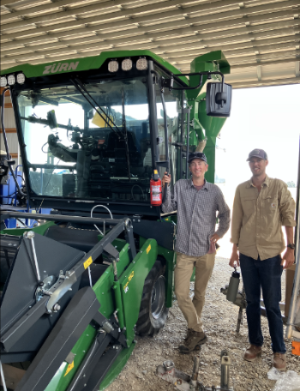
Trevor (right) and Greg Lutgen (left) standing next
to the program's new combine at the Post Farm.
The goal of Trevor’s research is to provide barley breeders with the information they need to develop varieties that can maintain malt quality under stressful conditions. He says, “The goal ultimately is to help producers achieve malt quality grade so they would receive more money for growing barley.”
The first step was testing his hypothesis that a longer grain fill period, the time between flowering and maturity, would help barley withstand environmental stress and management decisions. To uncover the answer, it took a lot of initial planning. “It is important to know how you want to analyze your data, and know what data you will need to collect from the field before you can do anything else,” he says. Once a plan was in place, varieties with different grain fill periods were planted and evaluated across varying environments and nitrogen treatments. The harvested varieties were then further evaluated in the lab to see how they responded to different levels of heat, drought, and nitrogen. After compiling and analyzing the data, Trevor found that barley varieties with extended grain fill periods more consistently produced seed that met malt quality standards under heat, drought, and increased nitrogen levels than varieties with shorter grain fill periods.
With evidence showing the benefits of longer grain fill, Trevor wanted to understand how the two quantitative trait loci (QTLs) for grain fill duration influenced malt quality under similar conditions. QTLs are regions on the DNA strand that are suspected to be connected to physical or quantifiable traits in an organism. Previous graduate student Dr. Jessica Williams identified two QTLs, one on chromosome 6 (6H) and one on chromosome 2 (2H), which were associated with grain fill duration and malt quality. To determine how each QTL affected these traits, Trevor used near-isogenic lines (NILs) for comparison. NILs are lines of barley that are almost identical in their genetic makeup, but differ only in the QTL regions.
The NILs were subjected to the same testing protocol as the previous experiment to see how the QTLs varied in response to stressors. The results confirmed that both QTLs were associated with extended grain fill. They also showed that the 6H QTL can consistently decrease protein and increase plumps across various environments, while the 2H QTL increased protein in some environments. These findings allow researchers to make more informed breeding decisions when incorporating these genetic regions into future barley varieties.
Within both experiments, Trevor also investigated whether extended grain fill could reduce the effects of overfertilization. Overfertilization is a common problem for producers growing malt barley, especially because fertilizer applications are often based on early-season yield estimates, which can be inaccurate if late-season heat or drought stress is present. Trevor hopes his research will help address this issue. He found that even under high nitrogen levels, extended grain fill can help barley maintain malt quality.
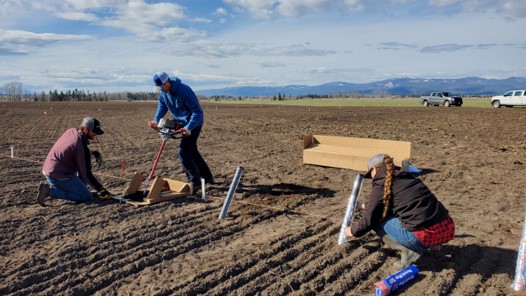
Trevor and others working on a previous project of his aimed at imaging root systems.
Trevor believes that his research matters beyond the lab by “supporting Montana agriculture, helping farmers be more sustainable financially and environmentally, and if they can do that then the barley market can have ample supply” for the production of food, animal feed, and most relevant to his work, beer.
When asked about the biggest issue facing barley production in Montana, Trevor identified a lack of water as a major concern for producers. Despite this challenge, he believes barley is more resilient than it is often given credit for. He says “barley is a pretty tolerant crop to a lot of things, and it’s definitely capable of making malt quality in dryland systems.”
Trevor’s research demonstrates how barley breeding can help Montana producers maintain malt quality under challenging conditions. His findings suggest that extended grain fill can help barley withstand heat, drought, and high nitrogen levels while still meeting malt quality standards. By identifying how specific QTLs influence these traits, his work provides valuable information for future barley breeding, which could ultimately help producers grow barley more sustainably. In summary, Trevor’s research highlights the potential for barley to remain a resilient and profitable crop for Montana agriculture.
Trevor currrently has published: Extended grain fill stabilizes malt barley quality across variable environments and nitrogen inputsand is expecting to have his paper involving the QTL regions published shortly.