

Montana K-12 Educator Needs Assessment Survey Report 2024


This report is also available in ScholarWorks
Limited print copies are also available; please contact smrc@montana.edu to make a request.
Authors
Data Analysis
Author Note
Table of Contents
Executive Summary
Introduction
- Primary Goals
- Secondary Goals
Methodology
- Sample
- Instrument
- Missing Data and Survey Completion
- Survey Modifications
- Data Analysis
Findings
- Descriptive Statistics
- Educator and School District Characteristics
- Grade Levels Taught and Years of Experience
- Community Size
- Geographic Region and Distance from a College or University
- Professional Development
- Total Professional Development Hours
- Online Professional Development Hours
- Professional Development Hours Required by Schools
- Hours of STEM Professional Development
- School/district strengths and weaknesses that impact PD implementation
- Barriers to Professional Development
- Access to High-speed Internet
- Digital Gatekeeping: Network Filters in K–12 Schools
- Attitudes Toward STEM Professional Development
- Access to STEM professional development
- 'Central' for Whom?
- Professional Development Location and Delivery Method Preferences
- Professional Development Timing and Duration Preferences
- Interest in Professional Development Topics
- Emerging Research Topics
- Interest in Resources Related to University Research
- Usefulness of and Interest in Data Sets and Associated Resources
- Usefulness of Data Sets
Discussion and Implications
- Access to Professional Development
- Technology Access and Online Delivery
- STEM Interest Across All Subjects
- PD Format and Timing Preferences
- Emerging Research Topics and Data Resources
- Connecting Educators with University Research
- Implications for Stakeholders
Conclusion and Recommendations
- Key Challenges
- Educator Preferences
- Interest in University Research
- Recommendations
Final Thoughts
References
Appendices
Appendix A – Relevant Elements of Montana NSF EPSCoR Strategic Plan
Appendix B – NSF Key Emerging Technology Areas
Appendix C – Survey Questions
Appendix D – Strengths & Weaknesses Select Open-Ended Question Responses
Appendix E – BARRIERS Select Open-Ended Responses Appendix F – PD FORMAT Select Open-Ended
Responses Appendix G – PD TIMING Select Open-Ended Responses Appendix H – Additional
Comments About PD Preferences
List of Tables and Figures
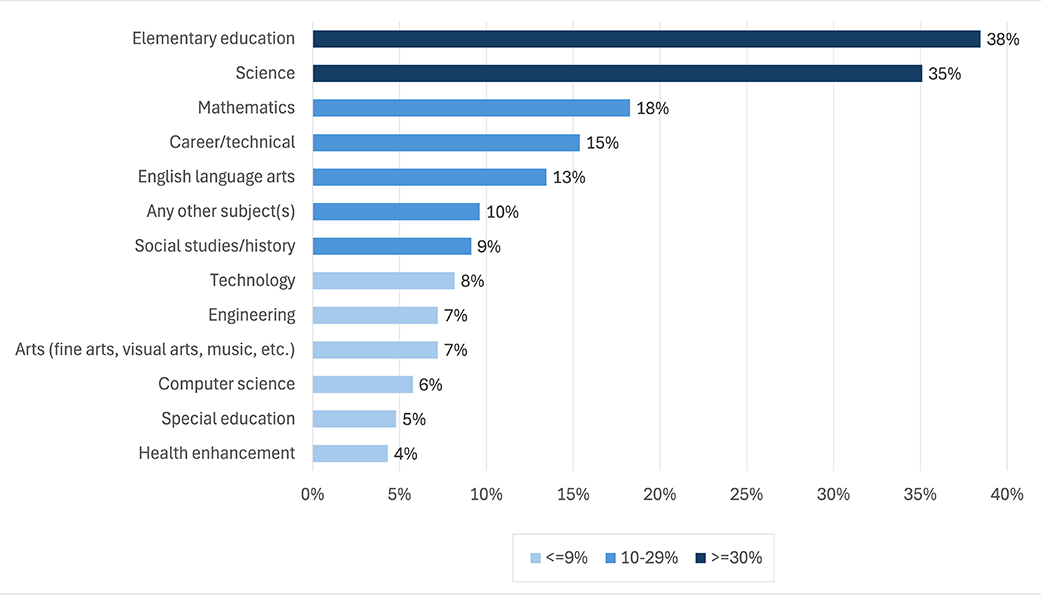
- Table 1. Subjects taught and STEM classification.
- Figure 1. Subjects taught.
- Table 2. Grade levels taught.
- Table 3. Years taught at the K-12 level, including the current year.
- Table 4. Community size, based on school location.
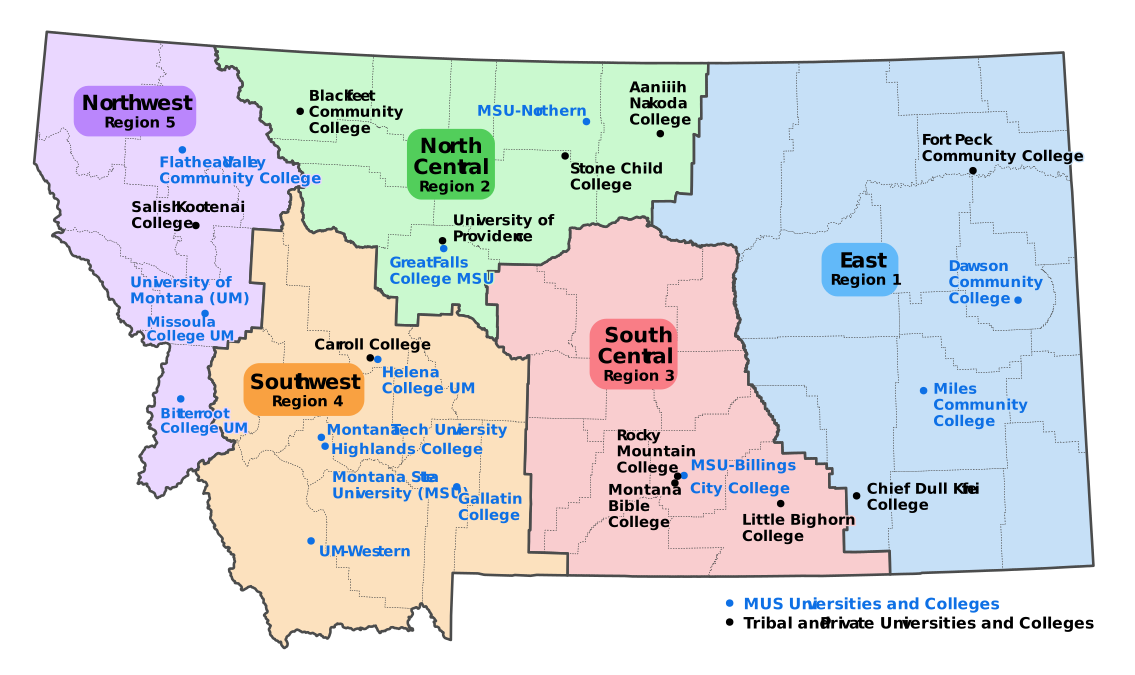
- Figure 2. Montana's Comprehensive System of Personnel Development (CSPD) regional council areas.
- Table 5. Distance from school district to nearest college/university.
- Table 6. Total PD hours completed in the past year.
- Table 7. Proportion of total PD hours completed online.
- Table 8. Proportion of total PD hours required by respondents' schools.
- Table 9. Proportion of total PD hours emphasizing STEM.
- Table 10. Perceptions of school/district factors as strengths or weaknesses in supporting high-quality PD.
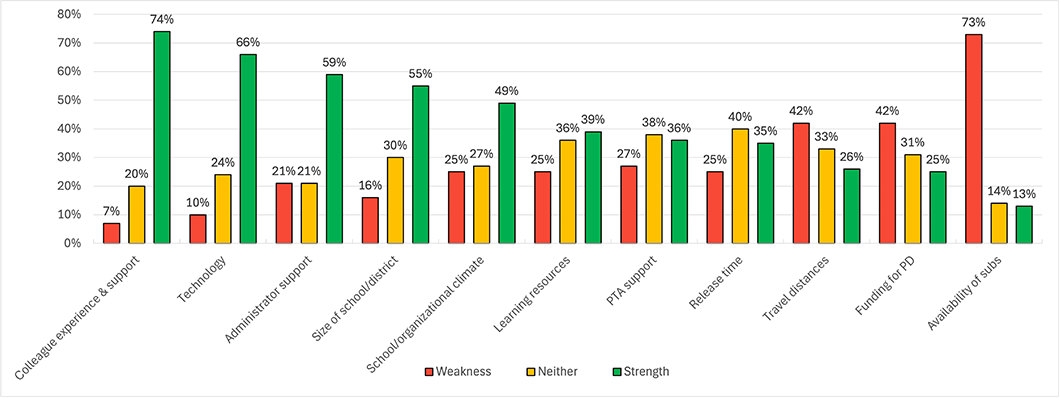
- Figure 3. Perceptions of school/district factors as strengths or weaknesses in supporting high-quality PD.
- Table 11. How often respondents have high-speed internet access, by community size.
- Table 12. Perceived value and feasibility of STEM PD in teaching practice.
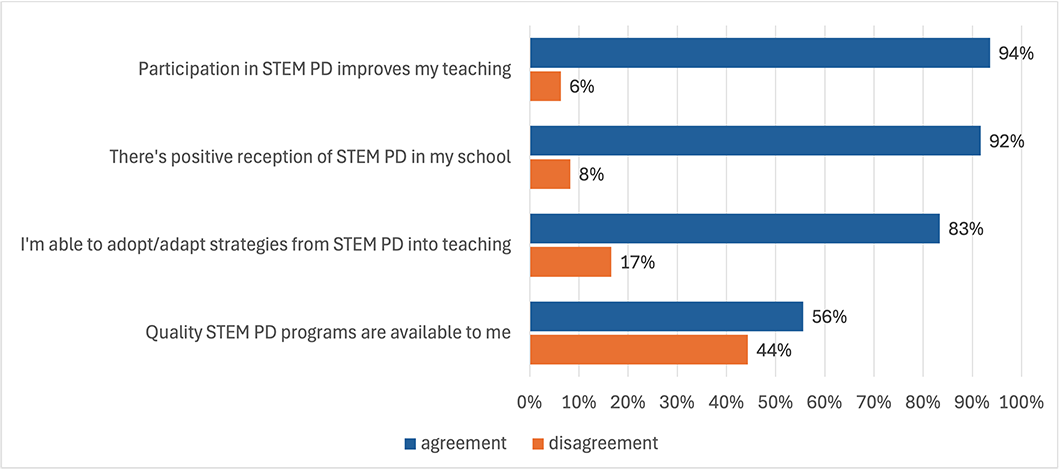
- Figure 4. Perceived value and feasibility of STEM PD in teaching practice.
- Table 13. Interest in various formats for participating in PD.
- Figure 5. Interest in various formats for participating in PD.
- Table 14. Interest in timing and duration of PD.
- Figure 6. Interest in timing and duration of PD.
- Table 15. Interest in 20 PD topics.
- Table 16. Familiarity with educational resources or PD for five research topics for which the Montana University System receives federal funding.
- Figure 7. Familiarity with educational resources or PD for five research topics for which the Montana University System receives federal funding.
- Table 17. Interest in educational resources or PD for five research topics for which the Montana University System receives federal funding.
- Figure 8. Interest in educational resources or PD for five research topics for which the Montana University System receives federal funding.
- Table 18. Interest in accessing datasets currently used by university researchers.
- Table 19. Perceived usefulness of four resources related to research datasets.
- Table 20. Interest in four resources or PD opportunities regarding university research.
Executive Summary
- Montana teachers of all subjects and grade levels are interested in and eager to expand their skills through professional development (PD).
- In particular, PD on STEM topics ranks highly in interest level and its perceived value to students—even among non-STEM teachers. However, access to high-quality STEM PD varies greatly, with many factors enhancing or inhibiting teachers’ capacity to take part.
- School district factors that positively affect teachers’ access to PD include supportive colleagues and administrators, school climate, school size and facilities/equipment, including technology (these remain largely unchanged from similar SMRC surveys in 2013 and 2020).
- Factors that adversely affect teachers’ access to high-quality PD include the school’s geographic location; availability of substitute teachers; and lack of funding, time to participate, and awareness of PD opportunities.
- Rural and small-school teachers often face unique barriers than do educators in larger communities, including the need to “wear many hats,” such as coaching or teaching driver’s ed. However, teachers in small schools and those with smaller class sizes often report more flexibility in how they schedule their time and curriculum.
- Montana computer science standards
- Educational technologies
- Place-based learning
- Local STEM industry/organization connections
- Linking classroom instruction to college and careers
- Integrating topics within STEM
- Integrating literacy practices with STEM learning
- Designing inquiry-based lab activities
- Engineering design practices
- Montana science and mathematics standards
Introduction
Primary Goals
- Understand the professional development landscape for Montana K-12 educators: Do they have adequate access to high-quality professional development? Are some geographic areas in greater need than others? Are some grade bands or subjects better served than others? Are educators taking advantage of available PD offerings?
- Discover what general PD topics are of interest to educators, particularly in the context of science, technology, engineering, and mathematics (STEM).
- Explore Montana K-12 educators’ preferences for PD, including time, duration, location, and delivery method (i.e., online, hybrid, in-person).
Secondary Goals
- Discover how to better connect the K-12 education community with the research findings of Montana NSF EPSCoR, a statewide research infrastructure-building effort with a current research focus on prescribed fire, including fire and smoke science; smart optical sensors for data gathering; artificial intelligence and machine learning to make sense of the large data sets gathered; and a social psychology, economics, and ethics thrust that examines how trust in information sources about prescribed fire and smoke can increase resilience and lead to better decision-making capacity.
- Gauge educators’ interest in other STEM topics of priority to the Montana State University research enterprise.
- Specifically, probe educators’ interests in using authentic research data sets from NSF EPSCoR and other ongoing research projects within the Montana University System.
Methodology
Sample
Instrument
Missing Data and Survey Completion
Survey Modifications
- Driving distance to nearest college: 87 (<20 miles), 72 (21–50 miles), 35 (51–100 miles), 13 (>100 miles)
- District size: 62 (<1,000 people), 31 (1,001–2,500), 44 (2,501–10,000), 19 (10,001–50,000), 49 (>50,000), 3 unsure
Data Analysis
Findings
Descriptive Statistics
Educator and School District Characteristics
|
STEM
|
Subjects
|
Percent
|
|---|---|---|
|
|
Elementary education*
|
38%
|
|
X
|
Science
|
35%
|
|
X
|
Mathematics
|
18%
|
|
|
Career/Technical Education (CTE)*
|
15%
|
|
|
English language arts
|
13%
|
|
|
Any other subject(s)
|
10%
|
|
|
Social studies/history
|
9%
|
|
X
|
Technology
|
8%
|
|
X
|
Engineering
|
7%
|
|
|
Arts (fine arts, visual arts, music, etc.)
|
7%
|
|
X
|
Computer science
|
6%
|
|
|
Special education
|
5%
|
|
|
Health enhancement
|
4%
|
Grade Levels Taught and Years of Experience
|
Grades
|
Percent
|
|---|---|
|
K-2
|
23%
|
|
3-5
|
30%
|
|
6-8
|
41%
|
|
9-12
|
40%
|
| Years | Percent |
|---|---|
| 0-2 | 9% |
| 3-5 | 14% |
| 6-10 | 19% |
| 11-15 | 19% |
| 16-20 | 13% |
| >20 | 25% |
Community Size
| Years | Percent |
|---|---|
| 0 - 1,000 | 30% |
| 1,001 - 2,500 | 15% |
| 2,501 - 10,000 | 21% |
| 10,001 - 50,000 | 9% |
| > 50,000 | 24% |
Geographic Region and Distance from a College or University
| Distance (miles) | Percent |
|---|---|
| <20 | 42% |
| 21 - 50 | 35% |
| 51 - 100 | 17% |
| >100 | 6% |
Professional Development
Total Professional Development Hours
| Number of hours | Percent |
|---|---|
| 1 - 2 | 1% |
| 3 - 10 | 8% |
| 11 - 20 | 32% |
| 21 - 40 | 25% |
| >40 | 32% |
Online Professional Development Hours
Educators were asked to estimate the proportion of their professional development hours completed online. The largest group said about half of their PD hours were online. Nearly half of respondents reported that one-quarter or fewer of their hours were online, while fewer than one in six completed nearly all their hours online.
| Response option | Percent |
|---|---|
| None or almost none | 23% |
| About one-quarter | 23% |
| About half | 25% |
| About three-quarters | 15% |
| All or almost all | 14% |
Professional Development Hours Required by Schools
Educators were also asked what percentage of the PD hours in which they participated were required by their school. The majority indicated that no more than half of their PD hours were required—suggesting that teachers have high degree of autonomy in their selection of learning opportunities.
| Response option | Percent |
|---|---|
| None or almost none | 18% |
| About one-quarter | 27% |
| About half | 24% |
| About three-quarters | 9% |
| All or almost all | 22% |
Hours of STEM Professional Development
Lastly, we wondered what percentage of teachers’ PD hours emphasized STEM (science, technology, engineering, and mathematics). Although only about half of respondents teach STEM classes (Table 1), about two-thirds of respondents have participated in STEM professional development. About 42% said that half or more of their hours focused on STEM.
| Response option | Percent |
|---|---|
| None or almost none | 34% |
| About one-quarter | 25% |
| About half | 20% |
| About three-quarters | 10% |
| All or almost all | 12% |
School/district strengths and weaknesses that impact PD implementation
Educators rated 11 variables as either strengths or weaknesses of their school or district in terms of impact on their participation in professional development. Descriptive statistics regarding school/district strengths and weaknesses are presented in Table 10 and Figure 3.
Educators overall expressed a strong need for more relevant, accessible and subject-specific PD. Key challenges include limited teacher choice in PD offerings, lack of support for science, math, and career/technical subjects, and barriers to access due to rural isolation, travel costs, and insufficient funding. Teachers also highlighted the importance of hands-on, practical learning experiences and collaborative opportunities to share and implement PD insights. Some respondents provided open-ended responses, listed in Appendix D.
A new strength/weakness variable was added to the 2024 survey: availability of substitute teachers. This factor emerged as the top weakness contributing to challenges with accessing high-quality professional development. In 2020, funding for professional development was the most frequently cited weakness; in 2024, it ranked second, following the lack of substitute teachers.
| Item | Weakness | Neither | Strength |
|---|---|---|---|
| Colleague experience & support | 7% | 20% | 74% |
| Technology | 10% | 24% | 66% |
| Administrator support | 21% | 21% | 59% |
| Size of school/district | 16% | 30% | 55% |
| School/organizational climate | 25% | 27% | 49% |
| Learning resources | 25% | 36% | 39% |
| PTA support | 27% | 38% | 36% |
| Release time | 25% | 40% | 35% |
| Below are variables that ranked higher as weaknesses than as strengths | |||
| Travel distances | 42% | 33% | 26% |
| Funding for PD | 42% | 31% | 25% |
| Availability of subs | 73% | 14% | 13% |
Factors that influence access to high-quality STEM professional development have remained largely unchanged since 2020, with one notable exception: technology. In 2020, about 26% of teachers considered technology to be a weakness; that number dropped significantly to only 10% in 2024. Also in 2024, nearly two thirds of educators (66%) listed technology as a strength, up from 59% four years earlier.
Figure 3. Perceptions of school/district factors as strengths or weaknesses in supporting high-quality PD, arranged in descending order by strength. (n = 206-208)
Barriers to Professional Development
- Having to pay out of pocket to attend – 86% agreement
- Not having enough time off from work – 68% agreement
- Family obligations – 62% agreement
Access to High-speed Internet
| Community size | Sometimes | Always |
|---|---|---|
| up to 1,000 | 15% | 85% |
| 1,001 - 2,500 | 29% | 71% |
| 2,501 - 10,000 | 23% | 77% |
| 10,001 - 50,000 | 26% | 74% |
| >50,000 | 12% | 88% |
No educators reported never having access to high-speed Internet. However, nearly one in five (19%) indicated that they only sometimes have access, a slight improvement from 2020, when 23% reported the same. In contrast, 88% now report always having access, up from 77% in 2020.
Digital Gatekeeping: Network Filters in K-12 Schools
Through external interactions (unrelated to this survey) with Montana educators, we
have also received reports that K-12 schools frequently use network content filters
that block certain online content and even entire platforms like social media (e.g.,
educator-focused Facebook groups). These filters may be applied both to the school
network and to district-owned devices, regardless of location, in compliance with
federal requirements and district policy (Federal Communications Commission, n.d.).
This is an important consideration when offering online educator PD, networking opportunities,
and other support.
Attitudes Toward STEM Professional Development
Access to STEM professional development
Educators were asked whether quality PD programs for STEM teaching, learning, and STEM integration are readily available to them. Overall, 56% agreed, while 44% disagreed or strongly disagreed. This is an increase from the 2020 survey, when only 35% of educators indicated that high-quality STEM PD was readily available.
2020/2024
As noted above, while this report indicates that access to STEM PD increased by 60% compared to 2020, responses to this question highlight that there is still a gap between the positive views of such topics relative to their availability: While 94% of all educators taking the survey (not just STEM educators) agree that participation in STEM or STEM integration PD would help to improve their teaching, only 56% of educators agree or strongly agree that they have access to such PD.
| STEM integration factor | Combined: strongly agree + agree | Strongly agree | Agree | Disagree | Strongly disagree | Combined disagree + strongly disagree |
|---|---|---|---|---|---|---|
| Participation in STEM PD improves my teaching | 94% | 46% | 48% | 6% | 0% | 6% |
| There's positive reception of STEM PD in my school | 92% | 29% | 62% | 8% | 0% | 8% |
| I'm able to adopt/adapt strategies from STEM PD into teaching | 83% | 25% | 58% | 14% | 2% | 17% |
| Quality STEM PD programs are available to me | 56% | 7% | 49% | 40% | 4% | 44% |
Figure 4. Survey respondents’ agreement with four statements regarding STEM and its integration in professional development. Blue bars represent the combined percentages of respondents who selected ‘agree’ or ‘strongly agree’ for each statement. Red bars represent the combined percentages of respondents who selected ‘strongly disagree’ or ‘disagree’ for each statement. Items are sorted in descending order by the level of agreement. Responses marked “don’t know” were excluded from the analysis.
 Professional Development Location and Delivery Method Preferences
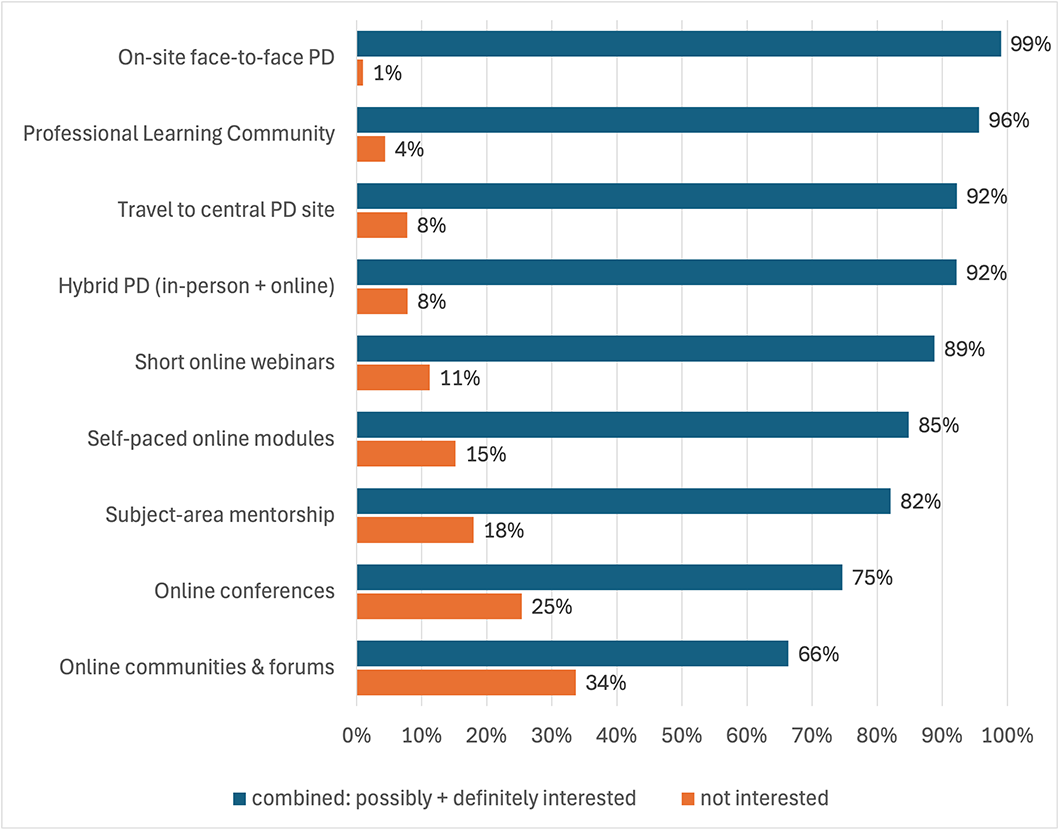
Educators were asked to rate their interest in various formats for participating in PD—whether offered in person, online, or through a combination of both—assuming the content was relevant to their subject area. Descriptive statistics are provided in Table 13 and Figure 5, which indicate preferences for in-person and collaborative learning formats. The most popular modes—based on the combined percentage of respondents who were ‘possibly’ or ‘definitely interested’—include:
- Face-to-face PD at their school
- Collaborating with other teachers in a professional learning community
- Face-to-face PD at a central location such as Billings, Bozeman, or Missoula (See box.)
- Participating in a hybrid model that incorporates some face-to-face time along with online follow up opportunities.
Open-ended responses indicated a preference for face-to-face interaction, hands-on learning, and peer collaboration. However, cost, travel constraints, and time limitations—especially for those in rural or remote areas—make online or hybrid formats more accessible and practical. While several educators expressed preferences for online PD (live or self-paced), one indicated the challenge with staying focused during lengthy virtual PD sessions. A few others emphasized the benefits of hybrid models, short and applicable sessions, or mentorship-based approaches.
No professional development formats received a majority of ‘not interested’ responses, but formats with the highest levels of disinterest were:
- Online communities and forums
- Online conferences lasting a half day or more
- Receiving mentorship from an expert teacher in their subject area*
- Self-paced online modules
*Despite nearly 40% of respondents having over 16 years of teaching experience, a significant majority of all respondents remained open to mentorship opportunities. This high level of interest suggests that even seasoned educators value continued growth through peer mentorship.
| Rank | PD format | Combined: possibly + definitely interested |
Definitely interested | Possibly interested | Not interested |
|---|---|---|---|---|---|
| 1 | On-site face-to-face PD | 99% | 70% | 29% | 1% |
| 2 | Professional Learning Community | 96% | 61% | 34% | 4% |
| 3 | Travel to central PD site | 92% | 40% | 52% | 8% |
| 4 | Hybrid PD (in-person + online) | 92% | 35% | 58% | 8% |
| 5 | Short online webinars | 89% | 37% | 52% | 11% |
| 6 | Self-paced online modules | 85% | 45% | 40% | 15% |
| 7 | Subject-area mentorship | 82% | 45% | 37% | 18% |
| 8 | Online conferences | 75% | 27% | 48% | 25% |
| 9 | Online communities & forums | 66% | 17% | 50% | 34% |
'Central' for Whom?
One participant expressed frustration with the term 'central locations' in the survey
question, noting that the examples listed (Billings, Bozeman, Missoula) were distant
from their area.
Another participant suggested two strategies that could alleviate such challenges:
- The Superintendent should organize and host high-quality professional development
events specifically for small rural schools.
- Rural districts should be informed of and invited to participate in PD opportunities
that are being hosted by larger, possibly better-resourced schools that are closer
than the 'central' locations listed in the survey.
Figure 5. Interest in various formats for participating in PD. Arranged in descending order by combined 'possibly interested' and 'definitely interested' responses. (n = 206)
Professional Development Timing and Duration Preferences
|
Rank
|
PD timing option
|
Combined: possibly + definitely interested
|
Definitely interested
|
Possibly interested
|
Not interested
|
|---|---|---|---|---|---|
|
1
|
Intensive summer workshops
|
87%
|
43%
|
43%
|
13%
|
|
2
|
Hybrid PD (start in-person; continue online)
|
87%
|
25%
|
62%
|
13%
|
|
3
|
PD during school hours
|
83%
|
38%
|
46%
|
17%
|
|
4
|
Evening PD
|
75%
|
18%
|
57%
|
25%
|
|
5
|
Weekend PD
|
72%
|
19%
|
53%
|
28%
|
Interest in Professional Development Topics
|
Rank
|
Research topic
|
Combined: possibly + definitely interested
|
Definitely interested
|
Possibly interested
|
Not interested
|
|---|---|---|---|---|---|
|
1
|
Montana computer science standards
|
100%
|
55%
|
45%
|
0%
|
|
2
|
Place-based instructional opportunities
|
97%
|
63%
|
34%
|
3%
|
|
3
|
Supporting learning with ed tech
|
97%
|
61%
|
36%
|
3%
|
|
4
|
Instructional strategies for diverse learners
|
97%
|
61%
|
36%
|
3%
|
|
5
|
Local STEM industry/organization connections
|
96%
|
64%
|
32%
|
4%
|
|
6
|
Classroom discourse and effective collaboration
|
96%
|
51%
|
44%
|
4%
|
|
7
|
Integrating literacy practices with STEM learning
|
93%
|
59%
|
34%
|
7%
|
|
8
|
Integrating concepts within STEM
|
93%
|
57%
|
36%
|
7%
|
|
9
|
Linking classroom instruction to college and careers
|
93%
|
57%
|
36%
|
7%
|
|
10
|
Designing inquiry-based laboratory activities
|
90%
|
49%
|
41%
|
10%
|
|
11
|
Integrating Indian Education for All
|
89%
|
60%
|
29%
|
11%
|
|
12
|
Engineering design practices
|
88%
|
50%
|
38%
|
12%
|
|
13
|
Culturally responsive instruction
|
87%
|
49%
|
39%
|
13%
|
|
14
|
Montana technology integration standards
|
86%
|
39%
|
47%
|
14%
|
|
15
|
Developing formative assessments
|
86%
|
44%
|
41%
|
14%
|
|
16
|
Montana science standards
|
86%
|
52%
|
34%
|
14%
|
|
17
|
Social and emotional learning
|
85%
|
52%
|
33%
|
15%
|
|
18
|
Integrating STEM concepts in a non-STEM classroom
|
84%
|
48%
|
36%
|
16%
|
|
19
|
Montana career and technical education standards
|
83%
|
44%
|
39%
|
18%
|
|
20
|
Montana math standards
|
77%
|
43%
|
33%
|
23%
|
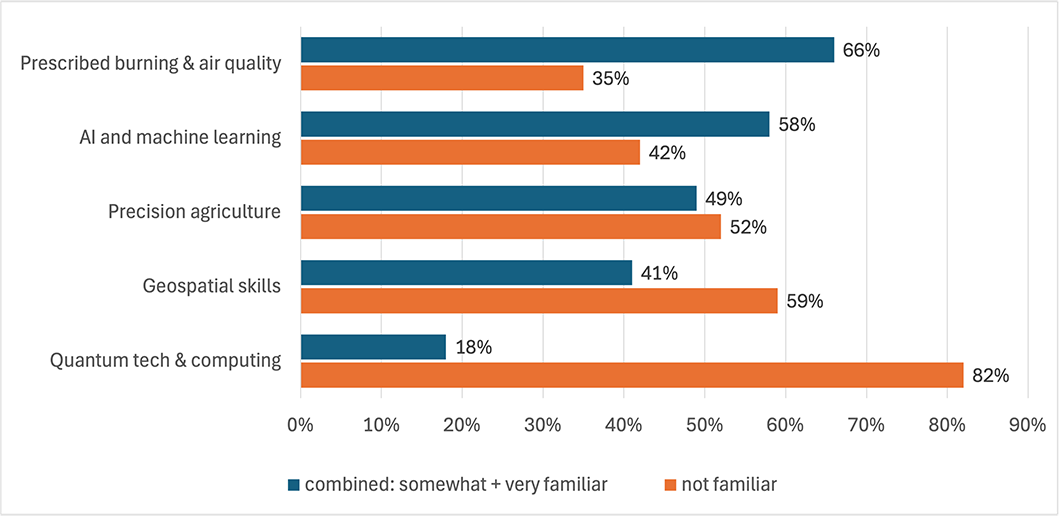
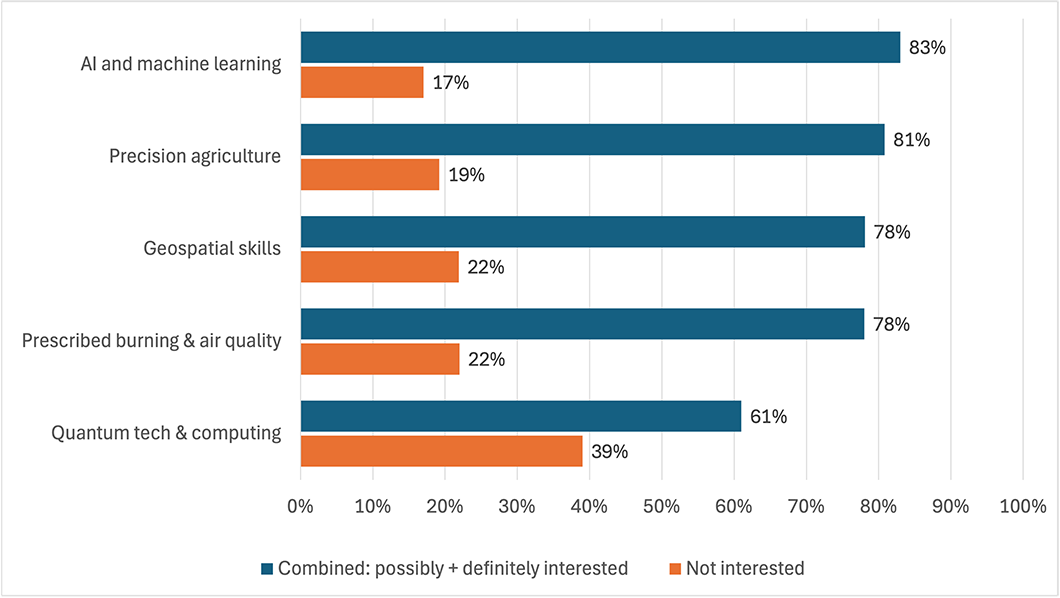
Emerging Research Topics
- Prescribed burning and air quality
- Artificial Intelligence and machine learning
- Quantum technologies and quantum computing
- Precision agriculture
- Geospatial skills
|
Rank
|
Research topic
|
Combined: somewhat
+ very familiar |
Very familiar
|
Somewhat familiar
|
Not familiar
|
|---|---|---|---|---|---|
|
1
|
Prescribed burning & air quality
|
66%
|
10%
|
56%
|
35%
|
|
2
|
AI and machine learning
|
58%
|
4%
|
54%
|
42%
|
|
3
|
Precision agriculture
|
49%
|
9%
|
40%
|
52%
|
|
4
|
Geospatial skills
|
41%
|
5%
|
36%
|
59%
|
|
5
|
Quantum tech & computing
|
18%
|
2%
|
16%
|
82%
|
|
Rank
|
Research topic
|
Combined: possibly + definitely interested
|
Definitely interested
|
Possibly interested
|
Not interested
|
|---|---|---|---|---|---|
|
1
|
AI and machine learning
|
83%
|
43%
|
40%
|
17%
|
|
2
|
Precision agriculture
|
81%
|
38%
|
43%
|
19%
|
|
3
|
Geospatial skills
|
78%
|
36%
|
42%
|
22%
|
|
4
|
Prescribed burning & air quality
|
78%
|
41%
|
37%
|
22%
|
|
5
|
Quantum tech & computing
|
61%
|
18%
|
43%
|
39%
|
Usefulness of and Interest in Data Sets and Associated Resources
Usefulness of Data Sets
|
Response option
|
Percent
|
|---|---|
|
Not interested
|
13%
|
|
Possibly interested
|
45%
|
|
Definitely interested
|
43%
|
|
Combined: possibly + definitely interested
|
87%
|
|
Selected choice
|
Percent
|
|---|---|
|
Standards-aligned lesson plans illustrating dataset applications
|
84%
|
|
Examples of dataset use for real-world problems
|
74%
|
|
PD on classroom use of datasets
|
72%
|
|
Just the raw data sets
|
27%
|
Interest in Resources Related to University Research
|
Item
|
Combined: possibly + definitely interested
|
Definitely interested
|
Possibly interested
|
Not interested
|
|---|---|---|---|---|
|
University researchers visit schools to share research with students
|
90%
|
50%
|
40%
|
10%
|
|
PD on data collection, cleaning, and visualization
|
84%
|
45%
|
39%
|
16%
|
|
PD on university research processes
|
81%
|
36%
|
45%
|
20%
|
|
PD on research instrument design, manufacture, and testing
|
83%
|
35%
|
48%
|
18%
|
Discussion and Implications
Access to Professional Development
Technology Access and Online Delivery
STEM Interest Across All Subjects
PD Format and Timing Preferences
Emerging Research Topics and Data Resources
Connecting Educators with University Research
Implications for Stakeholders
- PD providers should prioritize hybrid and in-school formats, offer subject-specific content, and reduce barriers related to cost and substitute coverage.
- University researchers can enhance broader impacts by working with education professionals to offer standards-aligned resources and engaging directly with educators through school visits and workshops.
- State agencies and funders may consider targeted investments in infrastructure, travel subsidies, and mentorship programs to support equitable access to PD across Montana.
- In summary, the 2024 survey data provide a roadmap for improving professional development in Montana: one that is responsive to educator needs, grounded in research, and designed to overcome systemic barriers.
Conclusion and Recommendations
Key Challenges
- Time constraints, including limited release time and scheduling conflicts.
- Remoteness, especially in rural districts where travel to PD events is costly and time-consuming.
- Cost, including out-of-pocket expenses and the financial burden of securing substitute teachers.
Educator Preferences
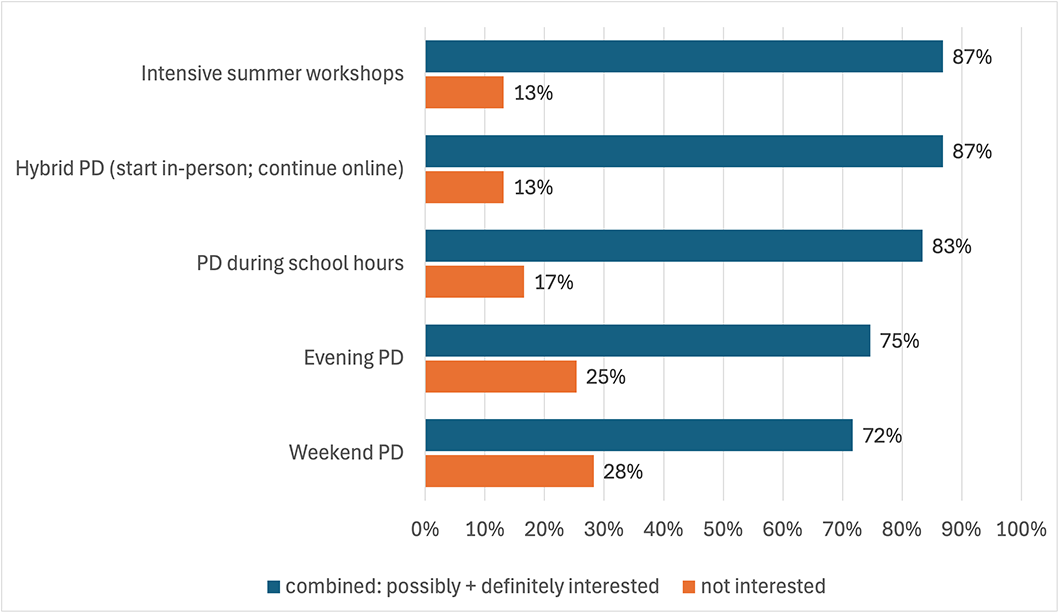
- Face-to-face PD at their own schools or regional hubs was most preferred.
- Hybrid models—starting with in-person sessions and continuing online—were seen as a practical compromise.
- Summer workshops and PD during school hours were favored over evenings and weekends.
- Collaborative learning with colleagues was highly valued, both during and after PD sessions.
Interest in University Research
- School visits from university researchers.
- PD on how scientists collect, clean, and use data.
- Resources that demonstrate real-world applications of research.
Recommendations
- Reduce logistical barriers by subsidizing travel, substitute coverage, and registration costs—especially for rural educators. Whenever possible, offer teachers a stipend for participating in PD.
- Expand hybrid PD models that begin with in-person engagement and continue online, allowing for sustained learning and collaboration. Keep virtual sessions interactive with breakout discussions and activities, and offer short, self-paced modules for educators needing flexible options.
- Develop standards-aligned resources that translate university research into practical classroom tools, including lesson plans and real-world data applications.
- Support mentorship and peer learning by fostering professional learning communities and encouraging collaborative PD experiences. When possible, support educators in sharing PD content more broadly with colleagues.
- Consult educators directly to tailor PD offerings to local needs, preferred formats, and subject-specific gaps. When possible, combine science content with other subjects such as math or English Language Arts (ELA).
- Leverage Broader Impacts plans in grant-funded research to include educator outreach, school visits, and resource development.
- Explore PD options with four-day week schools to see how this growing format affects educators’ preferences for, access to, and engagement with PD.
Final Thoughts
References
Arntzen, E. (n.d.). Four day school week. Office of Public Instruction, State of Montana. Retrieved September 2, 2025 from https://www.opi.mt.gov
Federal Communications Commission. (n.d.). Children’s Internet Protection Act (CIPA). Retrieved May 20, 2025, from https://www.fcc.gov/consumers/guides/childrens-internet-protection-act
Grimberg, B. I., & Hendrikx, S. (2013). Montana STEM educator needs assessment survey report. Science Math Resource Center, Montana State University.
Meyerink, M., & Taylor, S. (2021). Montana K-12 educator needs assessment survey report 2020. Montana State University NSF EPSCoR. https://scholarworks.montana.edu/server/api/core/bitstreams/74cc3437-8dae-4e2b-91c7-2eefa56a5573/content
Montana Office of Public Instruction. (2021). Computer science content standards. Retrieved May 20, 2025, from https://opi.mt.gov/Educators/Teaching-Learning/K-12-Content-Standards/Computer-Science
Montana Secretary of State. (n.d.). Professional development units for educator license renewal (Montana Administrative Rule). Retrieved May 10, 2025, from https://rules.mt.gov/browse/collections/aec52c46-128e-4279-9068-8af5d5432d74/policies/f1937be9-c102-40d1-9d70-7fbd1934f3e1
National Education Association. (2025). Rankings of the States 2024 and Estimates of School Statistics 2025. https://www.nea.org/sites/default/files/2025-04/2025_rankings_and_estimates_report.pdf
State of Montana. (n.d.). News and press releases. ConnectMT. Retrieved May 20, 2025, from https://connectmt.mt.gov/General-Information/News-and-Press-Releaseshttps://connectmt.mt.gov/General-Information/News-and-Press-Releases
U.S. Census Bureau, Population Division. (2024, May). Annual estimates of the resident population for incorporated places in Montana: April 1, 2020 to July 1, 2023 (SUB-IP-EST2023-POP-30). U.S. Department of Commerce. Retrieved May 10, 2025, from https://www.census.gov/
Appendices
APPENDIX A - RELEVANT ELEMENTS OF MONTANA NSF EPSCOR RII Track-1 STRATEGIC PLAN
SECTION 2: BROADER IMPACTS
SMART FIRES will transform wildfire and smoke mitigation strategies by firmly rooting the science of prescribed fire in validated data and predictive models. SMART FIRES builds capacity by forging ties between researchers in environmental science, remote sensing, optical engineering, AI, and social science. Activities will span institutions across the Montana University System (MUS) and include participants from Montana’s R1 universities, 4- and 2-year colleges and Tribal Colleges. Research activities including internships, collaborative projects and extramural partnerships will create a skilled workforce capable of leading multidisciplinary projects and of communicating the rationale, benefits and risks associated with prescribed fire to the public. SMART FIRES provides participants with economic development opportunities by leveraging existing ties between SMART FIRES researchers and robust and growing optics and remote sensing industries in Montana. Seed projects specifically dedicated to supporting STEM education at Montana’s Tribal Colleges will broaden participation in SMART FIRES-related project activities, and a separate seed project program will ensure that researchers at all MUS institutions and Tribal Colleges will be able to propose ideas that expand and deepen our understanding of prescribed fire. SMART FIRES strengthens Montana’s research and economic competitiveness, develops and mentors a new workforce trained in the science and impact of prescribed fire, and creates pathways to bring the results and consequences of academic discoveries into the hands of those professionals charged with managing public and private lands across the jurisdiction.
GOAL 2.1: EDUCATION AND WORKFORCE DEVELOPMENT (WFD)
APPENDIX B - NSF Key Emerging Technology Areas
- Advanced Manufacturing
- Advanced Materials
- Artificial Intelligence
- Biotechnology
- Communications and Wireless
- Cyberinfrastructure and Advanced Computing
- Cybersecurity
- Disaster Risk and Resilience
- Energy Technology
- Quantum Information Science
- Semiconductors and Microelectronics
APPENDIX C - SURVEY QUESTIONS
2024 Montana Teacher Professional Learning Survey
- Arts (fine arts, visual arts, music, etc.)
- Career/technical
- Computer science
- Elementary education
- Engineering
- English language arts
- Health enhancement
- Mathematics
- Science
- Social studies/history
- Special education
- Technology
- Any other subject(s)
Which grade level(s) do you teach? (Please select all that apply.)
- K-2
- 3-5
- 6-8
- 9-12
Including this school year, how many years have you taught at the K-12 level?
- 0-2 years
- 3-5 years
- 6-10 years
- 11-15 years
- 16-20 years
- Over 20 years
Professional Learning Hours
Approximately how many hours of professional learning have you participated in during the past 12 months?
- 0 hours
- 1-2 hours
- 3-10 hours
- 11-20 hours
- 21-40 hours
- More than 40 hours
Approximately what percentage of these professional learning hours were online?
- None or almost none
- About one-quarter
- About half
- About three-quarters
- All or almost all
Approximately what percentage of these professional learning hours were required by your school?
- None or almost none
- About one-quarter
- About half
- About three-quarters
- All or almost all
Approximately what percentage of these professional learning hours emphasized science, technology, engineering, and mathematics (STEM)?
- None or almost none
- About one-quarter
- About half
- About three-quarters
- All or almost all
School Site & District
- 0 - 1,000
- 1,001 - 2,500
- 2,501 - 10,000
- 10,001 - 50,000
- More than 50,000
- Don’t know
Please indicate the region in which your school district is located (see map above).
- Region I (East Montana)
- Region II (North Central Montana)
- Region III (South Central Montana)
- Region IV (Southwest Montana)
- Region V (Northwest Montana)
How far is your school district from the nearest college or university of any type?
- Less than 20 miles
- 21-50 miles
- 51-100 miles
- More than 100 miles
- Don’t know
In your school building, how often is reliable access to high-speed internet for viewing videos, streaming content, or participating in web conferences (e.g., Zoom) available?
- Always
- Sometimes
- Never
- Don’t know
Please indicate whether each of the following is a strength, weakness, or neither in your school district in terms of contributing to high-quality professional development.
| Response option | Strength | Neither/Unsure | Weakness |
| School/organizational climate | |||
| Administrator support | |||
| Parent teacher association support | |||
| Experienced and supportive colleagues | |||
| Release time | |||
| Technology | |||
| Learning resources (books, materials for labs, etc.) | |||
| Funding for professional learning | |||
| Size of school/district | |||
| Availability of substitute teachers | |||
| Travel distances |
- Not having enough time off from work is a barrier.
- Strongly agree
- Agree
- Disagree
- Strongly disagree
- Having to pay out of pocket to attend is a barrier.
- Strongly agree
- Agree
- Disagree
- Strongly disagree
- Family obligations are a barrier.
- Strongly agree
- Agree
- Disagree
- Strongly disagree
- Are there any other barriers to your participation in professional learning? Please describe. __________________________________
- Quality professional development programs for STEM teaching and learning and STEM
integration are readily available to me.
- Strongly agree
- Agree
- Disagree
- Strongly disagree
- I am able to adopt or adapt strategies learned from STEM or STEM integration professional
development into my teaching practice.
- Strongly agree
- Agree
- Disagree
- Strongly disagree
- My participation in STEM or STEM integration professional development would help to
improve my teaching.
- Strongly agree
- Agree
- Disagree
- Strongly disagree
- Professional development focused on STEM or STEM integration would be received positively
within my school.
- Strongly agree
- Agree
- Disagree
- Strongly disagree
Preferred Modes of Professional Learning
There are a variety of on-site, off-site, and virtual ways to participate in professional learning. Assuming the subject matter is relevant to you, to what extent would you be interested in participating in the following modes of professional learning?
- Attending face-to-face programs offered at my school site
- Definitely interested
- Possibly interested
- Not interested
- Collaborating with other teachers in my school or district in a Professional Learning
Community
- Definitely interested
- Possibly interested
- Not interested
- Traveling to face-to-face programs offered at a central location (e.g., Billings,
Bozeman, Missoula, etc.)
- Definitely interested
- Possibly interested
- Not interested
- Receiving mentorship from an expert teacher in my subject area
- Definitely interested
- Possibly interested
- Not interested
- Attending online webinars (1-2 hours)
- Definitely interested
- Possibly interested
- Not interested
- Participating in online conferences (half day or more)
- Definitely interested
- Possibly interested
- Not interested
- Completing online, self-paced learning modules
- Definitely interested
- Possibly interested
- Not interested
- Using online communities and forums such as discussion boards, wikis, and/or blogs
- Definitely interested
- Possibly interested
- Not interested
- Participating in a hybrid model that incorporates some face-to-face time along with
online follow-up opportunities
- Definitely interested
- Possibly interested
- Not interested
- Do you have any comments or suggestions on the format of professional learning that works best for you? ______________________________
Timing Format for Professional Learning
Timing is often a factor when deciding whether to attend a professional learning session. Assuming the subject matter is relevant to you and the location is convenient, to what extent would you be interested in participating in professional learning delivered in the following ways?
- Training or workshops during school hours
- Definitely interested
- Possibly interested
- Not interested
- Training or workshops in the evenings
- Definitely interested
- Possibly interested
- Not interested
- Weekend training or workshops
- Definitely interested
- Possibly interested
- Not interested
- Intensive summer workshops (3+ days)
- Definitely interested
- Possibly interested
- Not interested
- Initial face-to-face training with ongoing online meetings
- Definitely interested
- Possibly interested
- Not interested
- Please add any other comments you might wish to share about your professional learning preferences, especially any specific days/times/seasons that work well for you. ______________________________________
Interest in Professional Learning Topics
Based on your current teaching assignment, how interested would you be in participating in professional learning focused on each of the following topics?
- Designing inquiry-based laboratory activities
- Definitely interested
- Possibly interested
- Not interested
- Engineering design practices
- Definitely interested
- Possibly interested
- Not interested
- Developing formative assessments
- Definitely interested
- Possibly interested
- Not interested
- Classroom discourse and effective collaboration
- Definitely interested
- Possibly interested
- Not interested
- Instructional strategies for meeting the needs of diverse learners
- Definitely interested
- Possibly interested
- Not interested
- Integrating literacy practices with STEM learning
- Definitely interested
- Possibly interested
- Not interested
- Integrating STEM concepts in a non-STEM classroom
- Definitely interested
- Possibly interested
- Not interested
- Integrating concepts within STEM (e.g., science and math)
- Definitely interested
- Possibly interested
- Not interested
- Integrating Indian Education for All in the classroom
- Definitely interested
- Possibly interested
- Not interested
- Connections in my community/region to STEM-related industries and organizations
- Definitely interested
- Possibly interested
- Not interested
- Place-based instructional opportunities (e.g., inquiry projects related to local/regional
issues in the real world)
- Definitely interested
- Possibly interested
- Not interested
- Linking classroom instruction to college and careers
- Definitely interested
- Possibly interested
- Not interested
- Social and emotional learning
- Definitely interested
- Possibly interested
- Not interested
- Culturally responsive instruction (including all aspects of students’ culture)
- Definitely interested
- Possibly interested
- Not interested
- Montana career and technical education standards
- Definitely interested
- Possibly interested
- Not interested
- Montana computer science standards
- Definitely interested
- Possibly interested
- Not interested
- Montana math standards
- Definitely interested
- Possibly interested
- Not interested
- Montana science standards
- Definitely interested
- Possibly interested
- Not interested
- Montana technology integration standards
- Definitely interested
- Possibly interested
- Not interested
- Effective use of educational technologies to support student learning
- Definitely interested
- Possibly interested
- Not interested
- Please enter any additional comments about professional learning interests. __________________________
Resources or Professional Learning Interests by Topic
Assuming they are appropriate for your grade level, how interested would you be in receiving educational resources or professional learning related to the following topics?
- Prescribed burning and air quality
- Definitely interested
- Possibly interested
- Not interested
- Artificial intelligence and machine learning
- Definitely interested
- Possibly interested
- Not interested
- Quantum technologies and quantum computing
- Definitely interested
- Possibly interested
- Not interested
- Precision agriculture
- Definitely interested
- Possibly interested
- Not interested
- Geospatial skills
- Definitely interested
- Possibly interested
- Not interested
Topic Familiarity
What is your current level of familiarity with the following topics?
- Prescribed burning and air quality
- Very familiar
- Somewhat familiar
- Not familiar
- Artificial intelligence and machine learning
- Very familiar
- Somewhat familiar
- Not familiar
- Quantum technologies and quantum computing
- Very familiar
- Somewhat familiar
- Not familiar
- Precision agriculture
- Very familiar
- Somewhat familiar
- Not familiar
- Geospatial skills
- Very familiar
- Somewhat familiar
- Not familiar
Connections to Montana University Researchers & Data
Based on your current teaching assignment, how interested are you in having access to data sets that are currently being prepared and used by university researchers?
- Definitely interested
- Possibly interested
- Not interested
Which of the following would you find most useful? (Please select all that apply.)
- Just the raw data sets
- Examples demonstrating how the data sets can be used to demonstrate real-world problems
- Curated lesson plans providing examples as to how the data sets can be used and how they align with Montana standards
- Professional learning workshops on how such data sets can be used in the classroom
Based on your current teaching assignment, please indicate your level of interest in the following resources or professional learning opportunities.
- University researchers travel to my school to interact directly with students regarding
the research they are conducting
- Definitely interested
- Possibly interested
- Not interested
- Professional learning focused on how scientists collect, clean, visualize, and use
data
- Definitely interested
- Possibly interested
- Not interested
- Professional learning focused on the research process utilized by university researchers
- Definitely interested
- Possibly interested
- Not interested
- Professional learning focused on the design, manufacture, and testing of research
instruments
- Definitely interested
- Possibly interested
- Not interested
Do you wish to be entered into a drawing to win one of four $100 Amazon Gift Cards or one of 20 $25 gift cards? If you select yes, you will be redirected to a separate drawing survey to collect your contact information. Your responses to this survey will not be connected to your entry in the drawing.
-
-
- Definitely interested
- Possibly interested
- Not interested
-
Appendix D – STRENGTHS & WEAKNESSES - Select Open-ended Question Responses
- There is support for any professional development that teachers want to go to outside of our school year. The district has the budget to pay for it if the teachers push the paperwork through.
- We have had to work to get PD days put into our calendar. Also, finding funding for PD is a major issue.
- Our school district’s focus is on reading and math. Science comes last and many are not given time for it except for reading science articles. It is a sad barrier.
- I feel that there is a lack of choice for professional development. Often the pd is something that the district has selected, but does not necessarily relate directly to my content area. There have been professional development opportunities that I am willing to attend during my personal time (summer), but I am not willing to pay for. The district does not fund these opportunities.
- Our district has purchased an online computer-based science curriculum that completely removes all hands-on labs and activities from the classroom. This is happening in large districts across the state. We need support and professional development for our admin and curriculum directors about how destructive these types of curriculum materials are for students!!!!!
- Rural school where teachers are left to do what they think is best.
- Our district is extremely fortunate to have a vast amount of funding for professional development. Furthermore, our administrator is always supportive if we come to her with a professional development opportunity that we would like to partake in. She always says yes, never questions the amount, and assists with finding coverage (if necessary) to make it happen.
- more access and money for rural teachers to attend conferences in subject areas
- Funding for resources and materials is the biggest weakness in all subject areas for our district. I would include increasing class sizes due to staffing cuts in this category too.
- PD offered is poorly suited to individual teacher needs, PD is not offered frequently
- High-quality educators who realize that educator efficacy needs to be a holistic goal and not just something that a few do would make professional development meaningful.
- communication to teaching staff as to what professional development is available. I don’t know how to find what’s available.
- The biggest weakness is getting parents invested in their child’s education and encouraging them to come to school. Plus the lack of reliable substitute teachers.
- Cost of travel and stay because we live so far away from everything
- Enforcement of the student handbook would help immensely in classroom control.
- My school district is very connected to ACE [The Alliance for Curriculum Enhancement, a Montana-based professional development organization] for professional learning, so we are very active in the opportunities provided by ACE.
- MSSA [Montana Small Schools Alliance] and/or OPI [Montana Office of Public Instruction} and other sources sending information about PD opportunities.
- Time
- Having moved from Washington state six years ago, I felt like I went back in time about a decade when I came to MT. I think in my district current best practices, research, and implementation of vertically and horizontally standards-aligned curriculum are a weakness. While we’ve made progress, it is still an issue across the district.
- Over the past 6 years I have attended several professional developments that are STEM based. However, these are always geared towards elementary, even if they say they are k-8. I do not feel that I have the support or resources to give my middle/high school students the projects and applications of upper level mathematics. This causes the constant fight of “when are we going to use this”. I show examples and give explanations but students hardly ever believe that math is truly in everything.
- Top-down requirements take up all the time
- Weakness: professional development is sometimes disorganized and ineffective because of the wide range of grade levels and content areas.
- Struggling to survive low enrollment and no housing; professional development becomes a low priority
- Lack of subject specific affected by the district. I look to SEPA programs. [Science Education Partnership Award – a National Institute of Health program]
- Workload is an issue. It is hard to take time off during school hours and it is hard to make time outside of school hours.
- As a larger community/district in Montana our local options are fairly robust and varied however we are still challenged by travel distance and expense to any events/options outside our immediate community and a state or national level
- My school district does not offer any professional development. All that we do must be sought out.
- Weaknesses that could be improved include sub-coverage and dedicated funding for individual teacher professional development.
- I like to learn lessons that directly relate to my teaching. I am sick of being forced to attend PD that relates to people’s feelings. Sounds mean, but that is not going to help me teach required national standards.
- Teachers have a lot of “required” PD and often don’t want to go “above and beyond” those hours for additional training.
- We have high quality reading professional development. Math and science have not been prioritized.
- The district values professional development and invests heavily in it.
- The same course offerings are often offered from year to year. After 11 years it is becoming difficult to find one’s that I have not done.
- The best PD I have had over the years has been colleague driven. Every teacher in the building has their own niche and has something to add to the professional environment.
- Don’t ask what we want or what works
- Weaknesses would be that we are very rural and not many new or experienced educators want to move to the community. Our pay scale is lacking also. We are a long distance from anywhere. Strengths would be the small class sizes, and ability to communicate with parents.
- The School District and admin are open for any suggestions for the benefits of the faculty and staff especially our kids/students. Everyone is approachable and you can easily communicate with the admin including the faculty and staff.
- I believe admin should target areas of needs and have teachers take training in those areas. I worked in another state and our principal chose areas we were lacking and required a certain amount of hours in that area. The rest were up to us to decide what we wanted to take.
- Lack of subs and extreme distance are the main issues
- The isolation of the school district is definitely a weakness. The prairie view curriculum consortium that we belong to is a strength because they are always sending out ideas.
- When I have done the most inspiring, high-quality, useful PD I have felt like I am alone on a rocketship. We should have the opportunity to share PD learning amongst teachers and then built-in avenues for implementation.
- Have a pretty even split of newer teachers and veteran teachers.
- I feel like since COVID our district has switched to more of a focus on programs rather than developing good curriculum. It feels like there is less time for STEM, innovation now with all of the mandated programs we have which is very frustrating. I understand the need to have common materials at a point, but these programs take time away from our science and social studies.
- People are less willing to change and learn new things after being in education for a certain amount of time. The same types of PD’s get offered every year
- To turn a weakness into a strength would be to have the Superintendent host all of the small rural schools for a quality profess Development. In addition send the rural districts PD opportunities that larger area schools will be hosting.
- Being the largest districts in the state there are many professional development opportunities.
- I seek out professional development that is free to me. There is professional development that is offered in my school but I like to seek out other opportunities because I find that meeting with other individuals not in my school district I generate ideas they use in my own classroom.
- no longer a yearly requirement but still have to get 60 every 5 years to keep license. As an ag teacher I can really only go to ag themed PD for it to relate to me. Luckily we have lots of those.
- Honestly, I have found the best type of professional development is when we are able to travel far enough away from our responsibilities in the classroom to fill our cup.
- I answered “unsure/neither” on many of the questions because it seems the only type of PD the district supports is that which is offered by the district. Those days are usually pre-determined by district administrators, with no input from teachers. If teachers want to pursue any PD experiences on their own, they must do it on their own time with their own funds, and there is no reporting to the district. I’m happy to explain this answer further. :)
- Experienced teachers are helpful but if not asked no help is given willingly. Administrators are alway changing and not very helpful or nice.
- We have community resources such as the local museum that could be utilized more.
- Subject area content of professional development is a weakness in our district. The focus seems to centralize on English and related topics. While our district is fully supportive of us traveling to other places for content-specific PD, it’s never offered locally for career/tech subjects.
- Very high quality stem science projects done in real time + hands on student friendly experience.
- I think each district needs to survey teachers in order to find what needs should be met. Some require extra support while others want new ideas. I also believe the restraints imposed by our governmental leaders plays a major role. Education has some many cooks in the kitchen that never step foot into a classroom. I do love that fellow teachers work together to meet the needs of our students.
- The superintendent doesn’t value staff.
- We are so isolated it is hard to get professional development to our school. Most people fly into Billings and then 5 hours to get here. Not many people want to do that.
- Eager staff and supportive school board are strengths. Poor local schools create a weakness.
- I think we need more days as a district that are set aside specifically for high-quality PD.
- There’s no real emphasis on professional development. Those of us that pursue it, do so because we know it makes us better teachers.
- A strength would be an availability to complete online
- Staff like to learn and improve. Individually we will seek out different trainings and share what we’ve learned with the rest of the staff. This year had more troubles than usual with a poor leadership and loss of grants.
- Support of the administration in the professional development is limited.We are not given time to be send to be in person training even once a year.
- Our district focuses entirely on reading. It would be nice to be able to focus on something else.
- Funding is hard because we live so far from anywhere
APPENDIX E – BARRIERS – Select Open-Ended Responses
Clarifications are provided in brackets by the report authors to enhance understanding of the comments
Question: Are there any other barriers to your participation in professional learning? Please describe.
- In STEM fields, besides the science sectionals at MEA and this STEM conference, there isn’t much going on in Montana and we have to travel large distances. [The MEA – Montana Educators’ Association annual PD conference is now led by the Montana Federation of Public Employees – MFPE]
- Having to pay for subs, cost of professional development event, and hotel if needed.
- Money is my number one reason for not doing more professional development.
- My district is MUCH more likely to support us attending professional development if the cost of the substitute teachers are covered.
- Knowledge of opportunities out there. Sometimes I don’t know about them until after they are over.
- Not being able to find high quality training.
- Certain training is only offered through travel - no online option available.
- I try my best to keep my work life and home life separate, so PD during my free time is not usually something I look forward to.
- sub coverage and money to attend in the summer and pay for travel expenses
- Lack of motivation to put more personal time into this career that doesn’t pay a livable wage
- Unsupportive administration and having few subs available.
- Not offering professional development opportunities that include an option to attain CEU’s.
- Access to applicable professional learning
- Time is the main factor. Feeling obligation to be in the classroom is another barrier to professional learning during the school year.
- No other barriers, time and money are the biggest ones.
- Many of them are the same days/times as one another or are offered during the school day. Have no subs available, so need to have on days off.
- Location
- Lack of availability of the kind I need most: technology / specific applications training
- Organizing quality sub plans for students in order to take time off.
- Not enough relevant in person professional development nearby.
- Travel distance.
- distance needed to travel to get quality professional learning.
- Incentives to continue professional development.
- Health issues. I cannot drive myself to out-of-town conferences.
- Continued support and networking after professional learning.
- Having PD approved.
- Complicated process to get approval from the district for “credit” for PD outside of what is offered by the district.
- Knowing about events
- The biggest barrier is money for the professional development and for the travel.
- Quality professional learning often requires travel. Between hotels, meals, etc. It becomes very cost prohibitive.
- Time.
- Travel. Information on where to find PD sent out from OPI or from a district curriculum director.
- Substitute if the training isn’t in the summer
- Finding a substitute to take our classes and the amount of time it takes to prepare for sub.
- I think that these opportunities should not only be free, but teachers should also be paid for their time and effort.
- The distance for the school to the venues of workshop and seminars.
- Quality offerings
- Distance traveling
- Content not related to my subject area
- I have a hard time going to things because I don’t know any of the other teachers and I am the only science teacher at my school. Plus the other teachers are more experienced so they don’t ever want to go to the same sort of professional development as me.
- Distance to high quality, STEM conferences.
- Due to the location of our school, travel is a huge factor when deciding on professional learning. Opportunities that are virtual are a much appreciated and optimal choice for us.
- Just fitting it in the schedule ;-)
- Not getting paid to take PD. The expectation of our time without compensation.
- School year timing (when in the school year it is offered AND having notice of the PD early enough to ask for permissions to attend, pay, etc. usually PD does not give us enough heads up for all the approvals needed or is past our March budget deadline).
- Convincing administrators that it is important and necessary, and not just something that needs to be done on our own time.
- Not having team meetings for small schools to collaborate with other small schools.
- Often held after school 4pm-8pm, so very difficult to want to do after a work day
- Distance
- As an agricultural education teacher, I am out of the classroom a lot with my CTSO (FFA) being gone for my own professional development on top of my absences for my students is a challenge. [Career and Technical Student Organization]
- I think the fact that it feels disconnected to our role within the district.
- As a new teacher there wasn’t a very good mentoring program to help me figured out my first year smoothly. I was left figuring out things on my own most times.
- The district has to pre approve professional development in order for it to count as your hours.
- Again the isolation of my school.
- Virtual is more achievable than in person due to rural location.
- The cost and childcare can be a barrier for younger teachers
- Availability of topics that I feel pertain to my teaching.
- I spend a lot of time teaching driver’s ed outside of school hours.
- A lot of professional development opportunities are held throughout the week during summer break. For those who work summer jobs, it is hard to justify spending money to attend professional learning events while also losing out on money from a second job.
- Timing of professional learning opportunities occurring during busiest times at work.
APPENDIX F – PD FORMAT – Select Open-Ended Responses
Clarifications are provided in brackets by the report authors to enhance understanding of the comments
Question Text: Do you have any comments or suggestions on the format of professional learning that works best for you?
- I prefer in person learning.
- I have done both online and in-person professional development, and I much prefer in-person. The teacher-teacher interactions that are so important don’t seem to develop in online workshops.
- I get the most out of in-person professional development (and enjoy it the most too!), but I can’t afford to pay for those costs out of pocket (registration, sub costs, etc), so online offerings are more accessible in that regard.
- I am retiring so my interest is from a different viewpoint.
- I know that myself and a lot of my colleagues find it difficult to engage in long virtual meetings. I enjoy PD where I learn something that can be applied to multiple grade levels.
- Hybrid models are better in my opinion. It is nice to be able to do my individual work for the professional learning on my own time, but also being able to talk with other teachers face-to-face to discuss those things.
- What works best for me is zoom meetings that begin on or after 4:30pm weekdays. Would also be nice to have one offered during the October PD days, as an alternative to the State PD sessions. [The Montana Federation of Public Employees offers a statewide annual PD conference in October]
- Online is not effective for me.
- I prefer face to face
- I would like to see a variety of formats presented in short digestible and easy to implement sessions.
- I really enjoy hands on PD. The ASM camp I attended on materials science was excellent.
- In person is the best, but I don’t want to pay for travel or housing. Also, I have high quality training because I have searched it out and now have a network. I feel most teachers don’t have this…I didn’t the first 10 years of my career.
- I would like to observe teachers in their classrooms. I would like to see how students respond to material or methods and discuss the problem-solving and adaptations a teacher used to make the methods successful in their class. This could be done through video observation with a follow-up virtual q & a.
- While I understand the necessity of online options (and I have used them myself in the past) to reach isolated educators, I Really prefer at least some aspect of face to face. There is really no substitute for conversation and real time sharing resources and problem solving.
- I always seem to get more out of in-person courses where I can not only learn relevant topics, but also collaborate with fellow teachers.
- Establishing face to face connections first with online continued support works best for me.
- In-person, during school hours, aligned with my job responsibilities (special education).
- Summer opportunities; having presenters travel to our district or a co-op between districts
- Self-paced with mentorship for application of concepts and practices
- Hybrid is the most appealing to me… I can also help present.
- In the STEM field the best activities and labs and hands on activities I have experienced have been through the NSTA [National Science Teachers Association] conference. Each session was about an hour and you came back with learning materials and a new activity based on your teaching subject. Online tools can be helpful such as the middle school chemistry website from the American Chemist’s Society.
- none- mostly time constraints and lack of substitutes
- None
- This question was upsetting to me because we are located in Eastern Montana “Traveling to face-to-face programs offered at a central location (e.g., Billings, Bozeman, Missoula, etc.)” - THERE IS NO WAY THAT BOZEMAN OR MISSOULA ARE CENTRAL!!!!!! NO WAY! HOW CAN I MAKE MY POINT CLEAR HERE? HOW ABOUT EVERYONE FROM BOZEMAN AND MISSOULA TRAVEL TO MILES CITY FOR ONCE?
- Online works best due to the location of my school.
- In person for sure
- I am already in front of a computer all the time as a CS teacher. I am not interested in sitting in front of a computer any longer than I have to.
- Short and in-person and with food and coffee.
- Teachers don’t get enough time with other teachers from different areas to bounce ideas off of each other. We get too complacent in our own little districts and definitely need to branch out more but it’s hard to get admin to facilitate such meetings.
- Self paced courses have always been preferred, it is nice to be able to have the flexibility to complete a course at your own pace
- In person works best.
- Actually providing applicable curriculum that can be built on.
- Any format works for me if it is outside of office hours and flexible!
- Attending in person with a colleague so we can discuss strategies for integration that we can take back and implement immediately.
- I am a visual and hands on learning and prefer face to face. I know a good chunk of my colleagues like self paced learning opportunities. I’m an old fashioned type of learner… I enjoy face to face professional development opportunities.
- In person
- Please extend the reach to rural communities.
- Online, self-paced works the best right now with time and family commitments.
APPENDIX G – PD TIMING – Select open-ended responses
Question Text: Please add any other comments you might wish to share about your professional learning preferences, especially any specific days/times/seasons that work well for you.
- Out of school workshop days are easiest for teachers in my district to attend because of the substitute shortage.
- Summer works best. I need my weekends during the school year to recuperate and prepare for the next week.
- June and August are best
- Late September and October tends to be the best month for trainings.
- Weekdays during the summer would be best since I am not teaching all day every day during that time and I can still enjoy my weekends. That way I can also put more effort and focus into the work without all of my teaching distractions.
- With teaching and coaching evenings and weekends are usually full of games
- I truly feel like I get more out of in-person learning with the ability to ask real time questions. Self-guided learning where I can revisit a topic is also helpful.
- Would like more offered in July. Most are in June and overlap with one another. The October statewide PD days would be nice for an alternative instead of the State PD sessions. Fridays. Weekdays on or after 4:30pm.
- face to face (with hands on) is better. I am interested if it is not paid for by me - I have spent thousands over my career on my professional development!!!
- Our admin won’t give professional leave. Our teachers have to take personal days to attend educational conferences.
- It all depends on the days. Weekends and evenings are hard to attend during the year. Summers are best, but I can only attend if I don’t have other commitments. There isn’t really a best time, it just depends (which I know isn’t helpful). I also only attend when I have lodging and fees paid. For example, the STEM conference in Bozeman this year costs to attend and lodging is super expensive.
- Would not do anything not part of regular school day
- Weekday evenings or weekend conferences
- Early or late summer are the best times. Other times of the year are very busy for my family.
- Summer is OK, extensive multiple day workshops can be a bit much like the OPI summer institute. It is worth while going once, but it is a draining few days. Weekends and weeknights are off limits. In my opinion, PD should be done during school ours or the district should give allotted time for PD.
- summer works best
- I have young kids. Trying to find a sitter during the summer is hard.
- School days are ideal since we are building our professional skills. Other careers offer these trainings and usually pay for it. It is helpful to have substitutes available for classes left during that time.
- Occasional Fridays due to our hybrid 4day week schedule!
- With a lot of schools going to the four-day school week, Friday opportunities might be well received.
- Things that are scheduled near the beginning or end of the year, or around the semester change in mid-year are not convenient. Late fall or early spring tend to be the easiest times to make time for extra things.
- Anytime is a great opportunity!
- Summer is much better. Evenings are okay. I’m single and don’t have kids. I can afford to be flexible with my schedule as opposed to my counterparts.
- At the elementary level we’re already swamped with work and working well over 40 hours a week. Training during school hours would be the best choice to support teachers.
- Winter doesn’t work. We are a 4 day school. So Friday and Saturday would work.
- Weekends and Fridays. Our school is a 4 day / week program with Fridays off
- Spring is the worst time for getting away to attend professional development. February, November, and start of August or end of June seem to be the best times.
- The school year works better for me. I am pretty busy due the summer.
APPENDIX H – ADDITIONAL COMMENTS ABOUT PD PREFERENCES
- I would be interested in PD that uses our state standards and relates to engineering and IEFA [Indian Education for All]
- Learn to train OR write curricular materials for others.
- Step up to writing Online language arts tools Reduce AI writing the students papers
- The one I really want is “Effective use of educational technologies to support student learning”
- Inquiry-based learning is a need. There is not enough time to teach the standards in silos.
- I am concerned that at the college level neither I or my husbands professors (as part of a masters program) who were teaching educational technology were familiar with the SAMR model.
- Competency or proficiency based education and reporting
- I love any opportunity!
- I like hands-on activities
- Any PD that focuses specifically on K-1 level would be of great interest.