Homework Assignment #4
EE475���������������� Fall 2003
Assigned:� Thursday, October 30, 2003
Due AT THE START OF CLASS on
Thursday, November 13, 2003
A simple signal generator can
be constructed by sending a periodic sequence of digital values to a
digital-to-analog converter.� The
periodic sequence can either be calculated �on the fly� or a stored data table
can be used.
If you want to generate a
periodic signal with frequency f, the
mathematical expression is
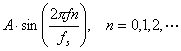
where A is the desired output amplitude and fs is the sampling
rate of the digital-to-analog converter (DAC).� If you are able to use floating point math,
the expression above can be implemented directly in software.� However, it may happen that floating point
math is too slow, or it may require too much program memory if the processor
does not have floating point hardware.�
In this case it may be possible to pre-calculate one cycle of the
desired sinusoid in advance and store it in a static memory array.� You will use both techniques in this homework
assignment.� Rather than writing to a
real DAC, you will write the results into a file as a sequence of integer
(text) values.
Problem #1:� Write a C program that generates several
cycles of a sinusoidal waveform using the floating point formula above, and
write the result as a text file.� The
output needs to be 16-bit 2�s complement integer numbers in text form, so round
the floating point number to the nearest integer before writing to the file.� Use A=32767,
and fs = 5 kHz in your
code.� The command line for your program
should be something like:
sine_gen� f� cycles�
out_file
where sine_gen is the name of your program, f is the desired sinusoid frequency in Hz, cycles is the integer number of waveform cycles to produce,
and out_file is the name of the output text file to be created.
Try several different
frequencies and observe several output cycles:�
comment on the periodicity of the output data.� What happens if the frequency f is not an integer factor of 5 kHz?
Problem #2:� Now modify your C program or create a new
program that uses a sinusoidal lookup table (as discussed in class) to generate
the output sequence instead of
calculating the sin() function on the fly.�
You must use the include file �sinetable.h�
from the course web site to define the lookup table data.
Use the same command line
format as for Problem #1.
You can use floating point
math to compute the sample increment and lookup index, but the output must come
from the lookup table.� You can use
either a �round to nearest� lookup strategy or linear interpolation.